Pages

Friday, April 18, 2014

BQ #4: Unit T Concept 3

Why is a “normal” tangent graph uphill, but a “normal” cotangent graph downhill? Use unit circle ratios to explain.

If we refer to the unit circle and ASTC, we know that tangent and cotangent are positive in quadrants 1 and 3 and negative in quadrants 2 and 4. If we were to break apart the unit circle into a line, we would get + - + - values for both trig functions. And unlike the other trig functions, tangent and cotangent have a period of pi rather than 2pi.

Tangent has the ratio of sin/cos (y/x), so we get asymptotes whenever cosine is equal to zero. On the unit circle, that would be the values of pi/2 and 3pi/2. If we were to draw out the graph, we notice that it goes "uphill" because each asymptote compresses an area where the graph would start with negative values and into positive values.


Cotangent has the ratio of cos/sin (x/y), so we get asymptotes whenever sine is equal to zero. On the unit circle, that would be the values of 0 and pi. If we were to draw out the graph, we would notice that it goes "downhill" because each asymptote compresses an area where the graph would start with positive values and into negative values.


Thursday, April 17, 2014

BQ #5: Unit T Concepts 1-3

Why do sine and cosine NOT have asymptotes, but the other four trig graphs do? Use unit circle ratios to explain.

Sine and cosine do not have asymptotes because their ratios: y/r and x/r. This means that the radius (r) will always be equal 1, and will never have a 0 as the denominator. Sine and cosine will not encounter asymptotes because we will never have an undefined answer (0 divided by any number).
Unlike sine and cosine, the other four trig graphs do include asymptotes. Cosecant has a ratio of r/y. The "y" value can be 0 in :(1,0) or (-1,0). Secant has a ratio of r/x and x can be 0 in : (0,1) and (0, -1). Cotangent and tangent have the ratios of x/y and y/x, which means either numerator can have the value of 0.

A crucial thing to remember is that cotangent and and cosecant have the same denominator in their ratios (y), which means they will have the same asymptotes. Tangent and secant will have the same asymptotes because their denominators in their ratios (x).

Wednesday, April 16, 2014

BQ #2: Unit T Concept Intro


How do the trig graphs relate to the Unit Circle?

Period? - Why is the period for sine and cosine 2pi, whereas the period for tangent and cotangent is pi?

When we refer back to the Unit Circle involving sine, cosine, and tangent, we remember ASTC to remember which trig function is positive for each quadrant.


If we refer to ASTC for sine, we know that the function would be positive in quadrants 1 and 2, and negative in quadrants 3 and 4. This creates the repetition of + + - -. When dealing with periods, we have to have a completed pattern. And since it takes the whole unit circle, which equals 2pi, to make that pattern repeat itself, the period is 2pi.


                                  http://www.regentsprep.org/Regents/math/algtrig/ATT5/sine77.gif


This idea also goes for cosine. The function is positive in quadrants 1 and 4, and negative in quadrants 2 and 3. This gives us the repetition of + - - +. Because it does not have a repeating pattern, a cosine period is also 2pi.
 
 
Unlike sine and cosine, a tangent period is only pi. Referring to ASTC, tangent is positive in quadrants 1 and 3 and negative in quadrants 2 and 4, which gives us the pattern of + - + -. Comparing to sine and cosine, we already have a pattern, but instead of going all the way around the unit circle for a period, we only need to go half way, or pi.
                                        http://www.clarku.edu/~djoyce/trig/tan.gif

Amplitude? – How does the fact that sine and cosine have amplitudes of one (and the other trig function)relate to what we know about the unit circle?
Amplitudes are half the distance between the highest and the lowest points on the sine and cosine graphs. Sine has the ratio of y/r and cosine has the ratio of x/r. R can only equal 1 (the radius of a unit circle is 1), which means the values x and y can only go up to 1. When dealing with the value of sine and cosine, we should know that sine and cosine have a value range of -1 to 1; anything out of that range would leave the trig function undefined. Now we look at other trig functions: tangent is y/x. We are not restricted to value range of -1 and 1 because we can divide by any other number. Cotangent is the reciprocal (x/y) of tangent. For cosecant and secant, they have the ratios of r/y and r/x. You can divide your "r", which is 1, by a smaller number, and get any value bigger than -1 or 1. That is why those other functions do not have amplitudes, but instead asymptotes.


Friday, April 4, 2014

Reflection #1: Unit Q: Verifying Identities

1.What does it actually mean to verify a trig identity?

To verify a trig function means to have a different version of the same trig function. We could have different trig functions in equations or fractions, but eventually reduces to one trig function.

2.What tips and tricks have you found helpful?

To get through this unit, it is crucial to memorize all the trig identities. It was easy to do because we had already learned and memorized all the reciprocal identities from a past unit. Also remember that reciprocal and ratio identities are able to power up or down, but not Pythagorean identities.

3.Explain your thought process and steps you take in verifying a trig identity.  Do not use a specific example, but speak in general terms of what you would do no matter what they give you.

To get through to verify a trig function, the first thing I do is look for any identities to simplify the function. I would look for any greatest common factors, cancel out, combine like terms, or it dealing with fractions, I would multiply the fraction by the conjugate to get a common denominator. If there are any tan or cot functions, I could use ratio identities to convert them to sin and cos, but one thing I remember is not to square anything because I am only allowed to square both sides. 

Tuesday, March 18, 2014

WPP #13-14: Unit P Concept 6 & 7: Applications with Law of Sines and Cosines

“Please see my WPP13-14, made in collaboration with Nga Mai, by visiting their blog here.  Also be sure to check out the other awesome posts on their blog”

Wednesday, March 5, 2014

I/D #2: Unit O: How can we derive the patterns for our special right triangles?

Inquiry Activity Summary:
1. 30-60-90 triangle
To derive the pattern for 30-60-90 triangles, we need to look at equilateral triangle, which has all equal side lengths and angle degrees. In this case, all sides are equal to 1. When we cut it down the middle, it splits the triangle into two 30-60-90 triangles.


Using the Pythagorean theorem to find our missing leg length, we plug in our values to get (1/2)^2+ b^2= (1)^2. The (1/2) came from the one side length that got cut into two. The (1) length would be our hypotenuse, which was already given to us. Now we solve for b to get √3/2


Now because we do not want any fractions to make things complicated, we multiply all the leg lengths by 2 to get "prettier" numbers.


Because we want to be able to apply this pattern for all 30-60-90 triangles with different side lengths, we need to use a variable to allow for the same ratios as the triangle with side lengths of 1.


2. 45-45-90 triangle
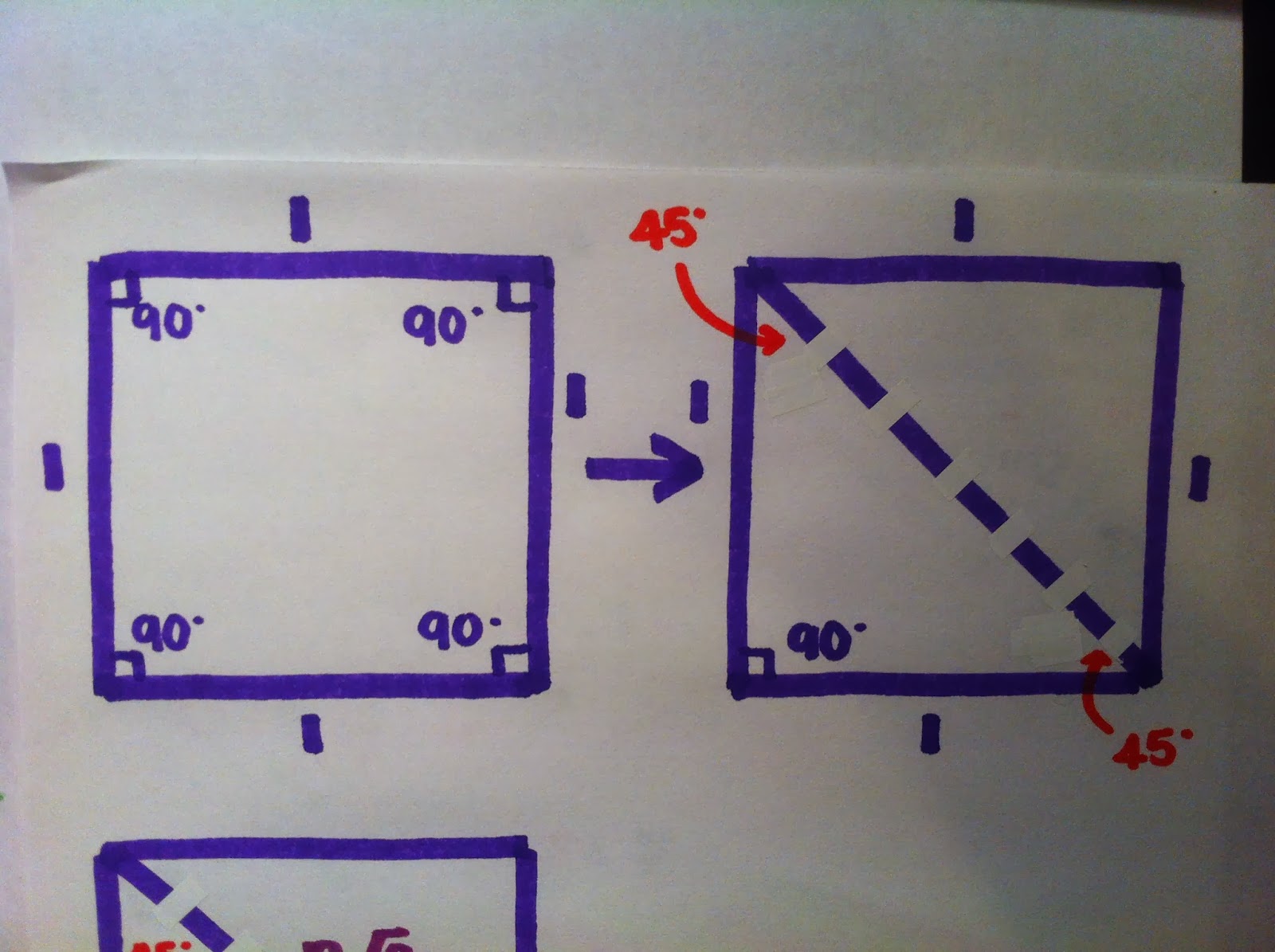
To derive the pattern for 45-45-90 triangles, we need to look at squares, which has all equal side lengths and angle degrees. In this case, all sides are equal to 1. When we cut it diagonally, it splits into two 45-45-90 triangles.


Using the Pythagorean theorem to find our missing leg length, we plug in our values to get (1)^2+ (1)^2= c^2. The (1) lengths would be our two legs, which was already given to us. Now we solve for c to get √2.


Because we want to be able to apply this pattern for all 45-45-90 triangles with different side lengths, we need to use a variable to allow for the same ratios as the triangle with side lengths of 1.


Inquiry Activity Reflection
 

1. Something I never noticed before about special right triangles is that the ratios came from the Pythagorean theorem.

2. Being able to derive these triangles myself aids in my learning because I now completely understand the rules of special right triangles. Through this activity, I understand where these values come from.